If you have tried two or three antidepressants and you still wake up in the same heaviness, you are not failing treatment. Treatment is failing you, and that is a meaningful clinical category. About one in three people with major depression do not get full relief from standard medication and therapy [1, 2]. Ketamine is one of the few options that works on a different mechanism, and for some people it works fast. It is also widely misunderstood, oversold by some clinics, and dismissed by others. This piece is the honest middle.
We will cover what ketamine is, what the evidence actually says about who responds, what a session feels like, the real risks, what NoMi Beach Health does, and the practical questions about cost and timing. If you are in crisis right now, skip to the bottom of this article for the 988 lifeline information before anything else.
What ketamine is, in plain language
Ketamine is an anesthetic medication that has been on the World Health Organization Essential Medicines List for decades. At anesthesia doses it puts people to sleep for surgery. At much lower, sub-anesthetic doses it produces a rapid antidepressant effect in some people. That effect was first documented in a small Yale trial in 2000 in 7 patients with depression, where a single IV dose produced significant symptom relief within hours [5]. That finding has been replicated many times since.
Ketamine works on the glutamate system, specifically NMDA receptors, which is a different pathway than the serotonin and norepinephrine systems most antidepressants target [8]. That mechanistic difference is part of why it can help people who have not responded to SSRIs, SNRIs, or bupropion. It does not mean it is stronger. It means it is different.
There are two main forms used clinically:
- Racemic ketamine given by IV infusion or intramuscular (IM) injection. This is the original form, used off-label for depression.
- Esketamine (Spravato) is a nasal spray, the S-enantiomer of ketamine, FDA-approved in 2019 for treatment-resistant depression and in 2020 for major depression with acute suicidal ideation [3].
Both work. They have different cost profiles, different administration logistics, and different insurance realities. We will get to that.
How depression is diagnosed and when ketamine enters the conversation
Major depressive disorder, by DSM-5 criteria, requires five or more symptoms over a two-week period including either persistent low mood or loss of interest, plus changes in sleep, appetite, energy, concentration, self-worth, or suicidal thoughts [1]. A clinical screening tool like the PHQ-9 helps quantify severity and track response over time.
Treatment-resistant depression (TRD) is generally defined as failure to respond to at least two adequate trials of antidepressants from different classes, each used at a therapeutic dose for at least 4 to 8 weeks. The FDA used that two-failure threshold for the Spravato approval [3]. APA and NICE guidelines suggest similar definitions [1, 9].
Ketamine and esketamine are most clearly indicated when someone meets TRD criteria. They are also considered earlier in cases of:
- Acute suicidal ideation, where waiting weeks for a standard antidepressant to work is not safe [6]
- Severe depression that is interfering with the person's ability to function, parent, work, or stay safe
- Depression with bipolar features in which standard antidepressants have caused destabilization
We do not push ketamine on people who have not given conventional treatment a fair try, because conventional treatment works for most people and is much cheaper and easier. We also do not gatekeep it from people who have suffered through years of failed regimens.
The treatment landscape, briefly
Before we go deeper on ketamine, here is the broader picture so you can see where it fits.
SSRIs and SNRIs (sertraline, escitalopram, fluoxetine, venlafaxine, duloxetine) are still first-line. They take 4 to 8 weeks to reach full effect. Roughly 40 to 60 percent of people respond to the first one tried [1].
Bupropion is a dopamine and norepinephrine reuptake inhibitor, often used when fatigue, low motivation, or sexual side effects from SSRIs are an issue.
Augmentation strategies add a second medication, like aripiprazole, lithium, or thyroid hormone, to a partial response.
Psychotherapy (CBT, interpersonal therapy, behavioral activation) has evidence comparable to medication for mild to moderate depression and is often more durable. Combining therapy with medication beats either alone for moderate to severe cases [1].
Transcranial magnetic stimulation (TMS) is a non-invasive brain stimulation, FDA-cleared for TRD. It is a real option, takes about 6 weeks of daily sessions, and is sometimes covered by insurance.
ECT (electroconvulsive therapy) is still the most effective treatment we have for severe and life-threatening depression, despite its reputation. It is underused.
Ketamine and esketamine sit alongside TMS as fast-acting options for people who have not gotten enough help from the above. They are not better in some absolute sense. They are different tools for different situations.
The point: there is no single treatment that helps everyone, and there is no shame in needing several tries.
What the evidence says about response and durability
Here is what the human trials actually show, with sample sizes so you can judge.
A 2013 randomized controlled trial in 73 patients with treatment-resistant depression compared a single IV ketamine infusion to a midazolam control. At 24 hours, 64 percent of the ketamine group met response criteria versus 28 percent of the midazolam group [7]. That study design, comparing to an active sedating control rather than placebo saline, was important because it ruled out the dissociative effect itself driving the result.
For esketamine nasal spray, the pivotal SUSTAIN-1 maintenance trial in 297 patients with TRD found that those continued on esketamine plus an oral antidepressant had a 51 to 70 percent lower risk of relapse compared to those switched to placebo plus an oral antidepressant [4]. The acute response rate in the short-term trials was around 50 to 70 percent for esketamine.
Across the IV ketamine literature, response rates in TRD cluster around 50 to 65 percent. Remission rates (full symptom relief) are lower, often 25 to 40 percent. A meta-analysis in suicidal ideation found significant reductions within 24 hours, with effects persisting up to a week from a single dose [6].
What this means in plain terms: roughly half to two-thirds of people with TRD will respond meaningfully. A meaningful minority will not. The effect is also not always durable from a single dose, which is why a series, often 6 infusions over 2 to 3 weeks, is the typical induction protocol, followed by spaced maintenance.
We are honest about this with patients. Some people walk in and have a clear shift after the first or second session. Some need the full series before it lifts. Some never respond, and we change course rather than keep going.
What a session actually looks like
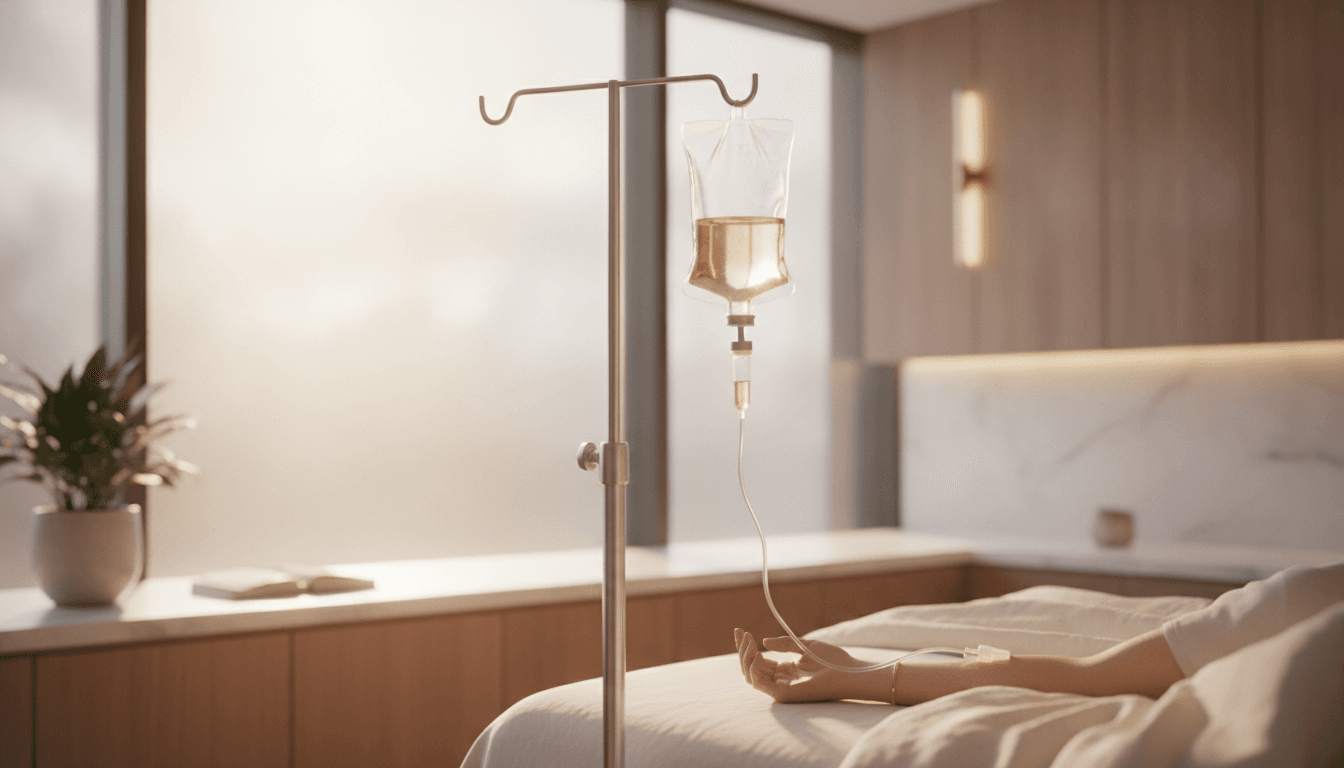
For an IV ketamine session, you arrive about 15 minutes early. We review medications, take vitals, and answer questions. The IV is placed, and a small dose of ketamine (typically 0.5 mg/kg) is infused over about 40 minutes. Some clinics use IM injection instead, which works similarly with a slightly different time course.
During the infusion, most people experience a dissociative state. Time slows or stretches. Body awareness changes. Some people see colors or geometric patterns with eyes closed. Some feel a sense of distance from their usual stream of thought. It is not sleep, and you can talk if you want to. We stay in the room or right outside, monitoring blood pressure and pulse.
The dissociative phase usually fades within 60 to 90 minutes of the start. Most people feel mostly normal an hour after the infusion, though tired and sometimes a little wobbly for the rest of the day. You cannot drive. You need a ride home. You should plan to take it easy.
The first session is the strangest. By the second or third, most people know what to expect and feel more settled.
Side effects and risks, honestly
Common, usually short-lived:
- Dissociation and altered perception during the session
- Mild nausea
- Increase in blood pressure and heart rate during the infusion
- Headache, dizziness, fatigue afterward
- Vivid dreams the first night
Less common, but worth naming:
- A small subset of people find the dissociative experience distressing rather than neutral. We adjust dose or stop.
- Bladder problems (cystitis) have been documented at high recreational doses over years. They are not a typical risk at therapeutic clinical dosing, but we screen.
- Liver enzyme elevations at very high or chronic doses.
- Tolerance and the theoretical risk of misuse. Ketamine is a Schedule III controlled substance. Clinical dosing protocols and clinic-administered care minimize this risk substantially.
Discontinuation: ketamine does not produce a classical SSRI-style withdrawal. People who respond and then stop maintenance can relapse, sometimes weeks to months later, which is why a maintenance plan is important.
Things to watch for that we screen carefully:
- Uncontrolled hypertension or active cardiac disease
- Active psychotic symptoms or untreated bipolar mania
- Pregnancy
- Substance use in active relapse, particularly alcohol or stimulants
- Severe, active liver disease
If any of those are in the picture, we either treat them first or recommend a different path.
Who is a candidate, and who is not
Generally a good candidate:
- Adult with a clear diagnosis of major depression
- Has tried at least two antidepressants from different classes without adequate relief, or has acute suicidal ideation that warrants a fast-acting option
- Stable medically, not pregnant, no untreated psychosis or active mania
- Has a support person who can drive after sessions
- Is willing to combine ketamine with therapy and medication management
Not the right fit, at least not now:
- Active psychotic symptoms, mania, or schizophrenia
- Uncontrolled cardiovascular disease or stroke history
- Pregnancy or current breastfeeding
- Active substance use disorder in relapse, particularly with ketamine, alcohol, or stimulants
- Cannot arrange transportation home from sessions
If you are not sure where you fit, the right move is a consult, not a guess.
The cost reality
This is where a lot of clinics get vague. We will not be.
Esketamine (Spravato) is FDA-approved and is sometimes covered by insurance for TRD with prior authorization. Out-of-pocket costs vary widely depending on plan and deductible. The medication itself is expensive, often $700 to $900 per treatment session before insurance, and the protocol typically requires twice-weekly sessions for the first month, then weekly, then every two weeks, all with a 2-hour observation period in clinic. Coverage approvals can take days to weeks.
IV or IM ketamine is used off-label and is almost always cash-pay. Per-session pricing in the US varies regionally but commonly runs $400 to $700 for an IV session, with a typical induction series of 6 sessions over 2 to 3 weeks, then maintenance every 2 to 6 weeks based on response. Plan on a realistic first-year cost in the range of $4,000 to $8,000 for IV ketamine alone, depending on protocol and maintenance frequency.
We quote exact pricing at the consult and put it in writing. We do not bury it in fine print.
What NoMi Beach Health does
We provide medically supervised IV and IM ketamine for adults with treatment-resistant depression, severe depression, and certain anxiety presentations. The intake includes a full psychiatric and medical history, medication review, screening for contraindications, and a clear treatment plan including expected session count, cost, and the role of therapy and medication management alongside the infusions.
We work alongside your existing therapist and prescriber when you have one. We help connect you to one when you do not. We do not sell ketamine as a standalone fix because that is not how it works long term.
Telehealth ketamine (oral or compounded) is offered by some companies. We do not do that. Our position is that the safety monitoring, dose control, and clinical setting matter, especially for the first treatments, and the in-person model gives a better margin for safety and response.
Realistic expectations and timeline
A typical course at our clinic looks like this:
- Week 0: Consult, intake, labs if needed, plan
- Weeks 1 to 3: Induction series, usually 6 sessions
- Week 4: Reassessment with PHQ-9 and clinical interview
- Weeks 5 onward: Maintenance every 2 to 6 weeks based on response, with re-evaluation every 3 months
Most patients who respond know within the first two to three sessions. We do not push a full series on someone who is showing no signal at all. We change the plan instead.
Therapy alongside ketamine matters. The infusions can produce a window of cognitive and emotional flexibility for days to weeks afterward, and structured therapy during that window can produce more durable change than the medication alone.
A note on stigma
Asking for help with depression is hard. Asking for help with depression that has not responded to ordinary treatment is harder, because part of you may have started to believe it is something about you that is broken rather than the condition itself. It is not you. Treatment-resistant depression is a clinical category with a real biology, not a character verdict. The fact that you are reading this is a sign of effort, not weakness.
If you have been on five medications, three therapists, and you are tired of starting over, we hear that. We do not need you to convince us you have tried hard enough. Most of our patients have. The job is to figure out together what is most likely to help next.
Crisis resources
If you are in crisis or thinking about hurting yourself, call or text 988 to reach the 988 Suicide and Crisis Lifeline, or go to your nearest emergency room. It is free, confidential, and available 24/7. You can also chat at 988lifeline.org.
If you would like to talk about whether ketamine therapy is appropriate for your situation, you can book a consult with us at NoMi Beach Health. We will give you an honest read, not a sales pitch, and we will say so clearly if a different path makes more sense.
Frequently Asked Questions
- Is ketamine a last resort or can I try it earlier?
- It is most often considered after two adequate antidepressant trials have not worked, which is the FDA criterion for esketamine (Spravato). Some clinicians, including us, will consider IV or IM ketamine earlier in carefully selected cases, especially with severe symptoms, suicidal ideation, or where waiting weeks for an SSRI to work is not safe. We make that call together.
- How fast does it actually work?
- For people who respond, the antidepressant effect can show up within hours to days of the first or second infusion. That is unusually fast. It is not magic and it is not universal. Roughly half to two-thirds of patients with treatment-resistant depression show meaningful response in the largest trials. The rest do not. We tell you that up front.
- Will insurance cover it?
- Esketamine (Spravato) has FDA approval for treatment-resistant depression and is sometimes covered by insurance with prior authorization. Generic ketamine used off-label by IV or IM is almost never covered, so it is typically cash-pay. We help you understand both options, including total realistic cost over a 6-week course.
- Do I need a referral or can I just book?
- You do not need a referral. We do require a medical and psychiatric intake so we can confirm ketamine is appropriate, check medications and medical history, and screen for conditions where it would not be safe.
- Will I still need therapy or other meds?
- For most people, yes. Ketamine works best as part of a plan that also includes psychotherapy and, often, a maintenance medication. The infusions can crack open a window. Therapy and lifestyle work are how that window stays open.
- What does a session feel like? Is it scary?
- Most people describe a dissociative, dreamlike state that lasts about 40 to 60 minutes. Time and body sensations feel different. Some find it strange but not unpleasant. A small minority find it uncomfortable. We stay with you, the dose is controlled, and you return to your normal awareness within an hour after the infusion ends.
Sources
- American Psychiatric Association. Practice Guideline for the Treatment of Patients With Major Depressive Disorder, Third Edition.
- National Institute of Mental Health. Major Depression Statistics.
- FDA Spravato (esketamine) Prescribing Information.
- Daly EJ, et al. Efficacy of Esketamine Nasal Spray Plus Oral Antidepressant Treatment for Relapse Prevention in Patients With Treatment-Resistant Depression. JAMA Psychiatry, 2019.
- Berman RM, et al. Antidepressant effects of ketamine in depressed patients. Biological Psychiatry, 2000.
- Wilkinson ST, et al. The effect of a single dose of intravenous ketamine on suicidal ideation: a systematic review and individual participant data meta-analysis. American Journal of Psychiatry, 2018.
- Murrough JW, et al. Antidepressant efficacy of ketamine in treatment-resistant major depression: a two-site randomized controlled trial. American Journal of Psychiatry, 2013.
- Krystal JH, et al. Ketamine: A Paradigm Shift for Depression Research and Treatment. Neuron, 2019.
- NICE Guideline NG222. Depression in adults: treatment and management.
- 988 Suicide and Crisis Lifeline.