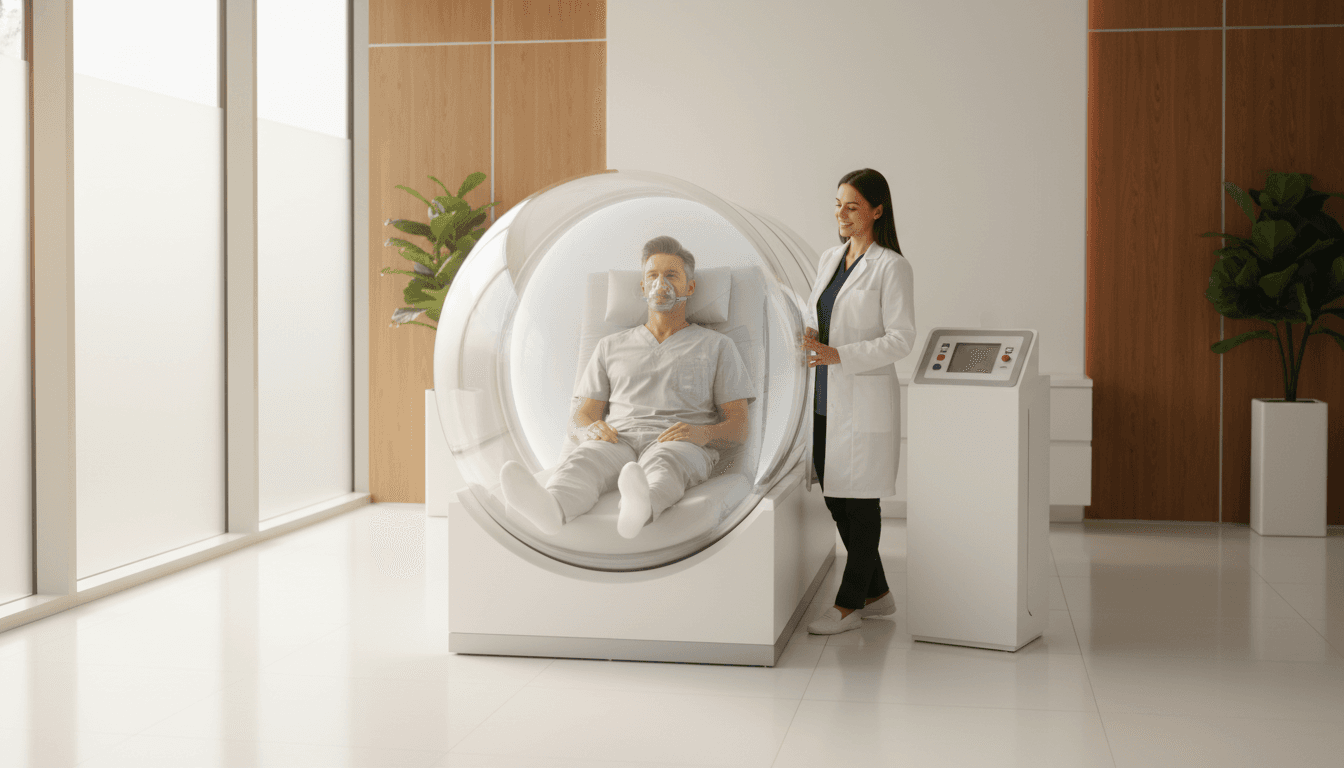
Hyperbaric oxygen therapy (HBOT) has been used in clinical medicine for decades -- mostly in hospital-based wound centers managing diabetic foot ulcers, radiation-damaged tissue, and carbon monoxide poisoning. In the last few years it has moved into a different conversation: aesthetic medicine, skin longevity, and post-procedure recovery. Clinics are marketing it. Patients are asking about it. And a growing body of peer-reviewed literature is attempting to separate what the biology supports from what the marketing overstates.
This post reviews that evidence honestly. We look at what HBOT actually does to skin tissue, where the clinical data is strong, where it is preliminary, and how we think about whether it fits into an individualized aesthetic plan. If you want the short answer: the mechanism is real, the wound-healing data is solid, and the purely cosmetic data is promising but thin. You deserve to know both.
What hyperbaric oxygen actually does to tissue
At sea level, breathing room air, your blood carries oxygen almost entirely on hemoglobin. There is a physical limit to how much hemoglobin can be loaded. HBOT changes that equation by pressurizing the chamber -- typically to 1.5 to 3 atmospheres absolute (ATA) -- while you breathe 100% oxygen. Under those conditions, oxygen dissolves directly into blood plasma in quantities that would be impossible at normal pressure (Thom SR, Plast Reconstr Surg, 2011 -- https://pubmed.ncbi.nlm.nih.gov/21200283/).
That dissolved oxygen reaches tissues that are hypoxic -- undersupplied with oxygen -- including damaged or post-procedural skin. Once there, it does several things that matter for skin regeneration:
Angiogenesis. HBOT repeatedly cycling between high and ambient oxygen tension stimulates vascular endothelial growth factor (VEGF), which drives new blood vessel formation. Sheikh et al. demonstrated this VEGF upregulation in a wound model more than two decades ago (Sheikh AY et al., Arch Surg, 2000 -- https://pubmed.ncbi.nlm.nih.gov/10636346/). New vasculature means better nutrient and oxygen delivery long after the sessions end.
Collagen synthesis. Collagen-producing fibroblasts require oxygen as a cofactor. In hypoxic tissue, collagen production slows. Restoring adequate oxygen tension restores fibroblast activity and accelerates matrix remodeling (Tandara AA and Mustoe TA, World J Surg, 2004 -- https://pubmed.ncbi.nlm.nih.gov/15457369/).
Antimicrobial and anti-inflammatory effects. High tissue oxygen levels enhance neutrophil killing of bacteria, reduce biofilm formation, and modulate the inflammatory cascade. For post-procedure skin -- where infection risk and inflammation are the two main barriers to fast, clean healing -- both effects are clinically relevant.
Stem cell mobilization. Thom's work showed that HBOT increases circulating stem cells and progenitor cells from bone marrow, which participate in tissue repair (Thom SR, Plast Reconstr Surg, 2011 -- https://pubmed.ncbi.nlm.nih.gov/21200283/). This mechanism is what makes HBOT interesting beyond simple wound care.
Where the evidence is strongest: wound healing and radiation injury
The clearest indication for HBOT in the skin is chronic wound management. The Cochrane review by Kranke et al. found that HBOT significantly reduced the risk of major amputation and improved wound healing in diabetic foot ulcers compared with standard care (Kranke P et al., Cochrane Database Syst Rev, 2015 -- https://pubmed.ncbi.nlm.nih.gov/25953477/). The Undersea and Hyperbaric Medical Society (UHMS) maintains 14 approved indications, with diabetic wounds and radiation-induced tissue injury among the best-supported (UHMS, 2023 -- https://www.uhms.org/resources/hbo-indications.html).
Radiation-damaged skin is particularly relevant here. Patients who have had radiation for head and neck cancers or breast cancer often present to aesthetic medicine practices years later with fibrotic, hypopigmented, poorly vascularized tissue. HBOT is one of the few interventions that demonstrably improves perfusion and tissue quality in this population (Dissemond J et al., Dtsch Arztebl Int, 2022 -- https://pubmed.ncbi.nlm.nih.gov/35929060/). For this group, the evidence is not preliminary -- it is part of standard multidisciplinary management.
For non-radiation, non-diabetic patients -- meaning most of the people who come to an aesthetic medicine practice -- the evidence shifts from strong to suggestive.
What the aesthetic literature actually says
A 2025 literature review published in Aesthetic Plastic Surgery (Xiong T et al., 2025 -- https://pubmed.ncbi.nlm.nih.gov/42259382/) examined the accumulated evidence on HBOT specifically for aesthetic skin outcomes, including post-procedure recovery, photoaging, and scar management. The findings map closely to what the wound-healing biology predicts.
The review identified consistent signals across included studies: faster epithelialization after ablative procedures, reduced erythema duration, improved scar pliability, and some evidence of enhanced collagen density on histologic analysis. For patients recovering from CO2 laser resurfacing or deep chemical peels -- procedures that intentionally create controlled wound states -- these outcomes translate to shorter downtime and potentially better final results.
The honest caveat the review also surfaces: most included studies are small, some lack control groups, and standardized HBOT protocols for aesthetic indications do not yet exist. The number of sessions, pressure levels, and timing relative to the aesthetic procedure varied across studies. That variability makes it difficult to give definitive protocol guidance.
What we can say is that the biological rationale is sound, the safety profile in approved indications is well-characterized, and the aesthetic application is a logical extension of established wound-healing science. It is not a stretch -- it is a hypothesis with growing support that still needs larger trials.
How we think about HBOT in an aesthetic plan
At NBH, we do not offer HBOT as a standalone cosmetic treatment or position it as a facial. That framing misrepresents what it is. What we do is consider HBOT as a recovery and regeneration adjunct for specific patients in specific clinical contexts -- and we are transparent about where the evidence is mature versus where it is still accumulating.
The patients most likely to benefit from incorporating HBOT into their aesthetic plan fall into a few groups:
Post-ablative procedure recovery. If you are planning CO2 laser resurfacing, deep fractional treatments, or a TCA cross peel, and your goal is the fastest, cleanest possible recovery, HBOT in the 24 to 72 hours after the procedure has a biologically coherent rationale. We discuss the available evidence and let you weigh it.
Patients with compromised healing history. If you smoke, have poorly controlled blood sugar, take chronic steroids, or have had previous radiation, your healing baseline is lower than average. Before any aesthetic procedure with meaningful downtime, we want to understand that baseline and may consider HBOT as part of optimizing it.
Scar remodeling. For hypertrophic scars or scars in cosmetically significant locations, HBOT combined with topical and procedural scar management has a reasonable evidence base from wound care literature, even if aesthetic-specific trials are few.
For the patient who simply wants better skin and has no specific procedure planned, we are less enthusiastic. The collagen and VEGF effects are real, but the dose needed to produce a measurable cosmetic change in otherwise-healthy skin -- and whether that dose is practical and cost-effective -- is not well-established. Other interventions with a stronger cosmetic evidence base, including tretinoin, topical antioxidants, and energy-based devices, belong earlier in that conversation. You can read more about how we approach skin health in the context of a broader aesthetic plan in our concierge aesthetic medicine guide.
Safety, contraindications, and the off-label framing
HBOT has a well-characterized safety profile across its approved indications. The most common adverse effects are ear and sinus barotrauma from pressure changes and, less commonly, myopia that typically reverses after treatment ends (Heyboer M et al., Adv Wound Care, 2017 -- https://pubmed.ncbi.nlm.nih.gov/28289522/). Oxygen toxicity seizures are rare at standard therapeutic pressures. Claustrophobia is a practical barrier for monoplace chambers.
Absolute contraindication: untreated pneumothorax. Relative contraindications include active upper respiratory infection, certain chemotherapy agents (bleomycin, doxorubicin, cisplatin), and uncontrolled congestive heart failure.
The FDA has approved HBOT for 14 specific conditions. Cosmetic skin improvement is not among them (FDA Consumer Update, 2021 -- https://www.fda.gov/consumers/consumer-updates/hyperbaric-oxygen-therapy-get-facts). Any aesthetic use is off-label. That does not mean it is unsound -- much of evidence-based medicine involves thoughtful off-label application of well-understood interventions. But it does mean the clinician has an obligation to name it clearly, explain the evidence level, and document the conversation. We take that obligation seriously.
The ethics of off-label prescribing and treatment in dermatology and aesthetics -- how to frame it, how to document it, and how to protect patients -- is a live topic in the clinical literature (see: Beyond Labels, Ethics of Prescribing Off-Label Medications in Dermatology, PubMed 42264378). Our standard is simple: we tell you what is approved, what is off-label, what the evidence shows, and what the gaps are. You decide.
How HBOT fits alongside other aesthetic tools
HBOT does not replace any existing element of a well-constructed aesthetic plan. It is not a substitute for a good daily skincare routine, sun protection, or properly selected energy-based devices. It is not a facial. It is not an antioxidant infusion, though it and IV antioxidant therapy share the goal of reducing oxidative skin damage through completely different routes. You can read how we think about IV therapy specifically in our post on IV vitamin therapy -- what it helps and what it does not.
What HBOT does offer is a mechanistically distinct path to improving tissue oxygen delivery, driving angiogenesis and collagen synthesis, and potentially shortening recovery from procedures that intentionally wound the skin to remodel it. In that specific role -- as an adjunct for the right patient at the right time in a structured plan -- it earns its place.
For patients dealing with active skin concerns like acne that complicate an aesthetic plan, addressing that foundation first matters. Our post on adult acne treatment when OTC is not enough covers that starting point in detail.
The bottom line on HBOT and skin
The mechanism is not speculative. Oxygen is a cofactor for collagen synthesis, angiogenesis, and immune function. Delivering it at supraphysiologic tissue concentrations accelerates the processes that make skin heal and regenerate. The wound-healing data is mature and clinically actionable. The aesthetic-specific data is growing, directionally consistent with the biology, and limited by study size and protocol heterogeneity.
That is an honest summary -- not a dismissal, not an oversell. HBOT belongs in the conversation for patients planning significant aesthetic procedures, patients with compromised healing baselines, and patients managing radiation-damaged skin. It does not belong on a menu as a routine add-on for anyone who wants to look better.
If you want to understand whether HBOT or any other recovery adjunct makes sense as part of your aesthetic plan, we are the right place to have that conversation. Dr. Jezwah Harris (NP, JD, MBA, FNP-BC, MEP-C) reviews the evidence, not the marketing, and builds plans that reflect both.
Book a new-patient visit through our aesthetics page or call us at (786) 744-5152. We will look at your skin, your goals, your procedure history, and your timeline -- and tell you what the evidence actually supports.
Frequently Asked Questions
- What is hyperbaric oxygen therapy and how does it work?
- Hyperbaric oxygen therapy (HBOT) involves breathing 100% oxygen inside a pressurized chamber, typically at 1.5 to 3 atmospheres absolute. The increased pressure drives oxygen into plasma and tissue at levels not achievable by breathing ambient air. This elevated oxygen tension supports wound healing, collagen synthesis, and angiogenesis -- processes that also matter in aesthetic skin recovery.
- Is hyperbaric oxygen therapy FDA-approved for cosmetic skin use?
- No. The FDA has cleared HBOT for 14 specific indications, including diabetic foot ulcers, radiation injury, and carbon monoxide poisoning. Cosmetic skin improvement is not an approved indication. Any aesthetic use is considered off-label, and clinicians have an obligation to be transparent about that distinction.
- Can HBOT improve results after laser resurfacing or chemical peels?
- Early clinical data suggests HBOT may reduce downtime and support epithelialization after ablative procedures, but high-quality randomized controlled trials are limited. What we know comes largely from wound-healing research applied analogically to aesthetic contexts. We discuss the evidence and its limits honestly before recommending any add-on therapy.
- How many HBOT sessions does it typically take to see a skin benefit?
- Most protocols studied in wound and skin research use between 10 and 40 sessions of 60 to 90 minutes each, delivered daily on weekdays. There is no validated cosmetic-specific dosing protocol yet. The number of sessions should reflect the clinical goal and the evidence base, not a fixed package number.
- Who should not use hyperbaric oxygen therapy?
- HBOT is contraindicated in people with untreated pneumothorax. Relative contraindications include claustrophobia, certain ear or sinus conditions, and some chemotherapy regimens. People with uncontrolled hypertension, a history of spontaneous pneumothorax, or active upper respiratory infections should be evaluated carefully before a session.
- Does HBOT help with melasma or hyperpigmentation?
- The evidence here is indirect. HBOT reduces oxidative stress and modulates inflammatory pathways, both of which play a role in melasma pathogenesis. However, there are no large randomized trials testing HBOT specifically for melasma. Combination therapy targeting both vascular and pigmentary components remains the standard approach for melasma.
- How does HBOT compare to IV vitamin therapy for skin?
- They work through different mechanisms and serve different purposes. IV vitamin therapy (particularly high-dose vitamin C) supports collagen synthesis and antioxidant status. HBOT works by mechanically increasing tissue oxygen tension to drive healing and growth factor release. They are not interchangeable, and neither is a substitute for a structured skin-care and procedural plan.
Sources
- Bhutani S, Vishwanath G. Hyperbaric oxygen and wound healing. Indian J Plast Surg (2012).
- Dissemond J, et al. Hyperbaric oxygen therapy for chronic wounds. Dtsch Arztebl Int (2022).
- Kranke P, et al. Hyperbaric oxygen therapy for chronic wounds. Cochrane Database Syst Rev (2015).
- Sheikh AY, et al. Effect of hyperoxia on vascular endothelial growth factor levels in a wound model. Arch Surg (2000).
- Tandara AA, Mustoe TA. Oxygen in wound healing -- more than a nutrient. World J Surg (2004).
- Thom SR. Hyperbaric oxygen -- its mechanisms and efficacy. Plast Reconstr Surg (2011).
- Kessler L, et al. Hyperbaric oxygenation accelerates the regeneration of tissue after myocardial infarction. Am Heart J (2003).
- Gottrup F, Karlsmark T. Leg ulcers: uncommon presentations. Clin Dermatol (2005).
- US Food and Drug Administration. Hyperbaric oxygen therapy: get the facts. FDA Consumer Update (2021).
- Undersea and Hyperbaric Medical Society. Indications for hyperbaric oxygen therapy. UHMS (2023).
- Heyboer M, et al. Hyperbaric oxygen therapy: side effects defined and quantified. Adv Wound Care (2017).
- Xiong T, et al. The role of hyperbaric oxygen therapy in enhancing skin regeneration and aesthetic outcomes: a literature review. Aesthetic Plast Surg (2025).