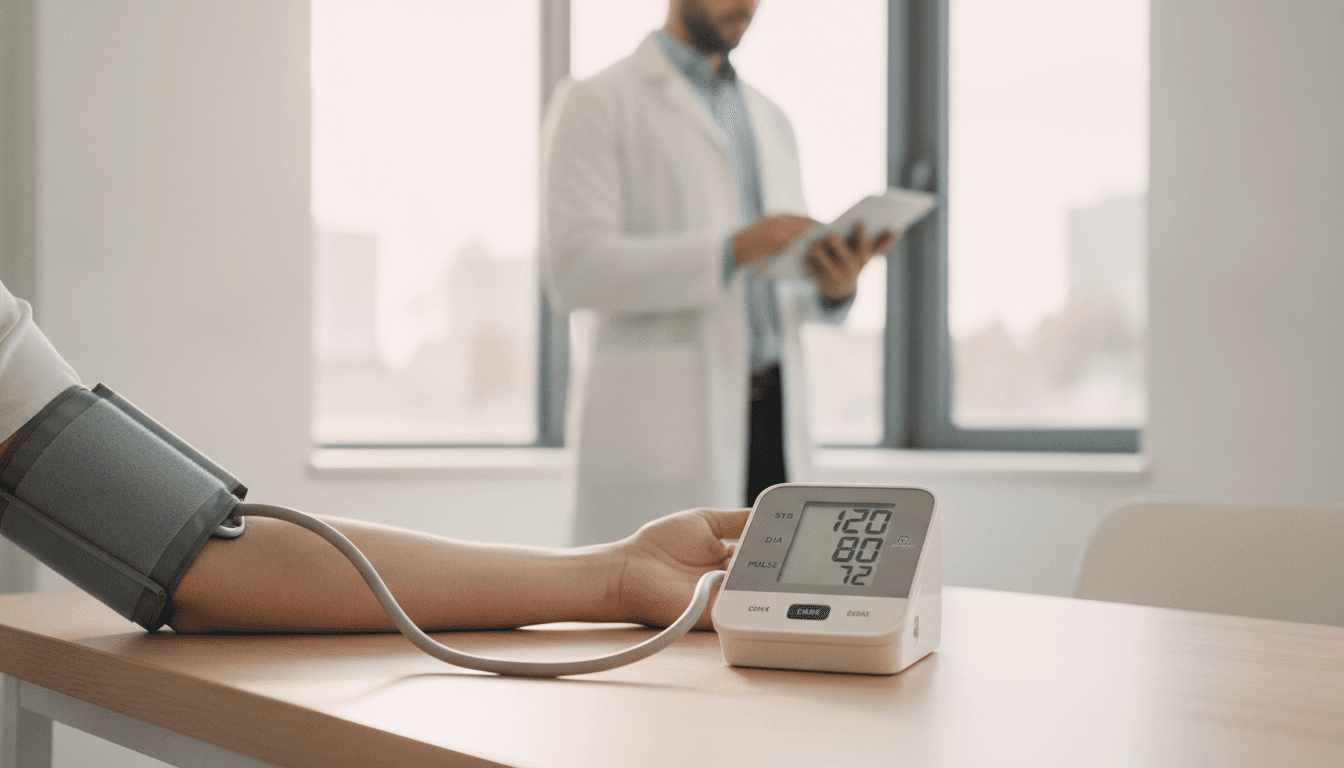
You get a blood pressure reading at a checkup, someone reads two numbers off a screen, and you walk out not entirely sure what they meant or whether you should be worried. Maybe the top number was a little high. Maybe it was fine last year and higher this time. Blood pressure is one of the most important numbers we track, and also one of the most misunderstood. This guide explains what the numbers mean, which category you fall into, how to measure well at home, and how we decide together whether the answer is lifestyle, medication, or simply keeping an eye on things.
What the two numbers mean
Blood pressure is written as one number over another, like 118/76. The top number is systolic pressure, the force in your arteries each time your heart beats. The bottom number is diastolic pressure, the force when your heart relaxes between beats and refills. Both are measured in millimeters of mercury, which is where the "mmHg" you sometimes see comes from.
Neither number is more important than the other, though systolic tends to matter more as we age because arteries stiffen over time. When a reading is high, it means your heart and blood vessels are working under more strain than they should be. Over years, that steady extra pressure is what quietly raises the risk of stroke, heart attack, kidney trouble, and heart failure. That is the whole reason we pay attention to a number that usually causes no symptoms at all.
The categories, in plain terms
The current categories come from the 2017 guideline written jointly by the American College of Cardiology and the American Heart Association (https://pubmed.ncbi.nlm.nih.gov/29133354/). Here is how they break down:
- Normal: less than 120/80.
- Elevated: systolic of 120 to 129 with diastolic under 80. This is a heads-up, not a diagnosis.
- Stage 1 high blood pressure: systolic of 130 to 139, or diastolic of 80 to 89.
- Stage 2 high blood pressure: systolic of 140 or higher, or diastolic of 90 or higher.
If your two numbers fall into different categories, the higher category is the one that counts. A reading of 138/78, for example, is stage 1 because of the top number.
A quick note on what these thresholds are not. They are not a switch that flips you from healthy to sick. They are a way of sorting risk so we know how closely to watch and how hard to act. Someone at 128/78 with no other risk factors is in a very different situation than someone at the same number who smokes and has diabetes. The category is the starting point of the conversation, not the end of it.
Why your readings keep changing
Patients often worry when their home readings bounce around. This is one of the most common questions we hear, and the reassuring answer is that some variation is completely normal. Blood pressure is not a fixed setting. It rises and falls throughout the day in response to stress, caffeine, physical activity, pain, a full bladder, poor sleep, and even the temperature of the room. It is naturally lowest during sleep and surges in the morning.
Because of this, a single reading is a snapshot, not the full story. What we actually care about is the pattern across many readings over days and weeks. There is also a real phenomenon called white-coat effect, where the stress of a medical office pushes the number up even in people whose pressure is normal at home. That is exactly why guidelines recommend confirming elevated office readings with measurements taken outside the clinic before making a diagnosis (https://www.uspreventiveservicestaskforce.org/uspstf/recommendation/hypertension-in-adults-screening). One high number in our office is a reason to look closer, not a reason to reach for a prescription.
How to measure correctly at home
Home monitoring is genuinely useful, but only when it is done well, and small mistakes can shift a reading by a surprising amount. A joint statement from the American Heart Association and the American Medical Association endorses home monitoring as a core part of managing blood pressure when the technique is right (https://www.ahajournals.org/doi/10.1161/CIR.0000000000000803).
Here is what good technique looks like:
- Use a validated automatic cuff that goes on your upper arm. Wrist and finger devices are less reliable and are not recommended (https://www.heart.org/en/health-topics/high-blood-pressure/understanding-blood-pressure-readings/monitoring-your-blood-pressure-at-home).
- Skip caffeine, exercise, and smoking for 30 minutes beforehand, and empty your bladder.
- Sit with your back supported and both feet flat on the floor. Do not cross your legs.
- Rest quietly for five minutes before you start, and do not talk during the reading.
- Rest your bare arm on a table so the cuff sits at about the level of your heart.
- Take two readings a minute apart, at the same times each day, and write them down.
One more tip that clinicians rely on: bring your home monitor to an appointment once so we can check it against our equipment and confirm you are getting consistent results (https://pubmed.ncbi.nlm.nih.gov/30827125/). A cuff that reads six points off in either direction can send you down the wrong path.
Lifestyle or medication? How we decide
This is the question most people really want answered, and the honest reply is that it depends on your numbers, your other risk factors, and what a few weeks of good home readings show. For elevated readings and many cases of stage 1 without other heart risks, lifestyle changes come first, and they work. Reducing sodium and following an eating pattern rich in vegetables, fruit, and whole grains, known as the DASH approach, lowers blood pressure meaningfully, and the two together do more than either alone (https://pubmed.ncbi.nlm.nih.gov/11136953/). Regular movement, limiting alcohol, losing excess weight, and treating poor sleep all pull in the same direction.
Medication enters the picture when readings sit in stage 2 territory, when stage 1 comes alongside diabetes, kidney disease, or existing heart disease, or when lifestyle changes have had a fair trial and the numbers are still high. This is not a failure on your part. Blood pressure has a strong genetic component, and some people do everything right and still need help from a prescription. When we do reach for medication, the specific drug matters, because different classes control pressure differently over a full day rather than just at the moment of a clinic visit (https://pubmed.ncbi.nlm.nih.gov/20206534/). The goal is steady control around the clock, not a single good number on the day you happen to be seen.
Why steady monitoring is the real win
If there is one idea worth keeping, it is that consistent monitoring beats occasional alarm. A run of readings taken well at home tells us more than a lone number pulled during a rushed visit. It shows us your true pattern, catches problems early, and, just as often, reassures us that a scary one-off reading was just that. It also lets us see whether a change we made, whether a new medication or a month of less salt, is actually working.
Blood pressure rewards patience and routine. You do not need to check it ten times a day or panic over a single spike. You need a reliable cuff, good technique, a habit of writing the numbers down, and a clinician who will read the whole story with you.
If your numbers have crept up, if your home readings look inconsistent, or if you simply want to understand where you stand and what to do next, we would be glad to walk through it with you. Our primary care team will review your history, confirm your readings the right way, and give you a clear, unhurried plan, whether that means lifestyle steps, medication, or watchful monitoring. You can book a primary care visit online or call us at (786) 744-5152.
Frequently Asked Questions
- What do the two blood pressure numbers actually mean?
- The top number (systolic) is the pressure in your arteries when your heart beats. The bottom number (diastolic) is the pressure when your heart rests between beats. Both matter, and readings are written as systolic over diastolic, such as 118/76.
- What is a normal blood pressure reading?
- Under the 2017 ACC/AHA guideline, normal is less than 120/80. Elevated is 120 to 129 systolic with a diastolic under 80. Stage 1 high blood pressure is 130 to 139 over 80 to 89, and stage 2 is 140/90 or higher (https://pubmed.ncbi.nlm.nih.gov/29133354/).
- Why is my reading different every time I check?
- Blood pressure naturally rises and falls all day in response to stress, caffeine, activity, sleep, and even a full bladder. One number is a snapshot, not the whole picture. That is why a pattern across several readings tells us far more than any single result.
- How do I measure my blood pressure correctly at home?
- Use a validated upper-arm cuff, not a wrist device. Sit with your back supported and feet flat, arm at heart level, and rest quietly for five minutes first. Avoid caffeine, exercise, and smoking for 30 minutes beforehand, then take two readings a minute apart (https://www.heart.org/en/health-topics/high-blood-pressure/understanding-blood-pressure-readings/monitoring-your-blood-pressure-at-home).
- Does one high reading mean I have high blood pressure?
- Not by itself. Guidelines recommend confirming elevated numbers with readings taken outside the clinic before diagnosing hypertension, because in-office anxiety can push the number up (https://www.uspreventiveservicestaskforce.org/uspstf/recommendation/hypertension-in-adults-screening). A single high reading starts a conversation, not a prescription.
- Can I lower my blood pressure without medication?
- Often, yes, especially with elevated or stage 1 readings and no other risk factors. Reducing sodium, following a diet rich in fruits and vegetables, moving regularly, limiting alcohol, and improving sleep all lower blood pressure measurably (https://pubmed.ncbi.nlm.nih.gov/11136953/). Whether that is enough on its own depends on your numbers and overall risk.
- How often should I have my blood pressure checked?
- The USPSTF recommends yearly screening for adults 40 and older or anyone at higher risk, and every three to five years for lower-risk adults 18 to 39 (https://www.uspreventiveservicestaskforce.org/uspstf/recommendation/hypertension-in-adults-screening). If you are already being monitored or treated, we usually check more often until things are stable.
Sources
- Whelton PK, et al. 2017 ACC/AHA Guideline for the Prevention, Detection, Evaluation, and Management of High Blood Pressure in Adults. Hypertension (2018).
- American Heart Association. Monitoring Your Blood Pressure at Home (patient resource).
- US Preventive Services Task Force. Hypertension in Adults: Screening. JAMA (2021).
- Shimbo D, et al. Self-Measured Blood Pressure Monitoring at Home: A Joint Policy Statement From the AHA and AMA. Circulation (2020).
- Muntner P, et al. Measurement of Blood Pressure in Humans: A Scientific Statement From the American Heart Association. Hypertension (2019).
- Sacks FM, et al. Effects on Blood Pressure of Reduced Dietary Sodium and the DASH Diet. New England Journal of Medicine (2001).
- Rothwell PM, et al. Effects of beta blockers and calcium-channel blockers on within-individual variability in blood pressure and risk of stroke. Lancet Neurology (2010).