Most of what gets sold as skincare has thin evidence behind it. Tretinoin is the exception. It has been studied in controlled trials since the late 1980s, it has measurable effects you can see under a microscope rather than only in a mirror, and it is inexpensive. If you were allowed exactly one prescription for your skin, this would be a defensible choice.
It is also the product people abandon most often, and almost always for the same two reasons: they used far too much at the start, and they expected results on a timeline the research never promised. Both are avoidable. This post covers what tretinoin actually does, what the trials measured, and how to start it in a way that you can sustain.
What tretinoin is
Tretinoin is all-trans retinoic acid, the biologically active form of vitamin A. That word "active" is the important part. Your skin cells have receptors that respond to retinoic acid directly. Tretinoin binds them without needing conversion.
Over-the-counter retinol is a precursor. Your skin has to convert it, in more than one step, before anything happens. Some of it arrives, more slowly and in smaller amounts. That is not useless, and for very sensitive skin it is a sensible on-ramp. But it explains why a prescription and a drugstore jar are not interchangeable, and why the trial evidence lives overwhelmingly on the prescription side.
When those receptors are activated, several things follow. Skin cells turn over faster and more normally, which stops dead cells and oil from plugging pores. Collagen production in the dermis increases. Abnormal pigment production settles. These are structural changes, which is why they take months and why they persist while you keep using it.
What the evidence actually shows
Two separate bodies of research matter here, and they are often blurred together in marketing.
For photoaging, the foundational work is now more than thirty years old and has held up. In randomized vehicle-controlled trials, tretinoin emollient cream produced measurable improvement in fine wrinkling, roughness, and mottled pigmentation in sun-damaged facial skin (https://pubmed.ncbi.nlm.nih.gov/1552056/). Crucially, biopsy studies confirmed the change was structural rather than cosmetic, showing histologic changes in treated skin rather than just a smoother surface appearance (https://pubmed.ncbi.nlm.nih.gov/2024984/).
Lower concentrations work too. Tretinoin 0.02% showed benefit in photodamaged facial skin across two double-blind studies (https://pubmed.ncbi.nlm.nih.gov/11534915/), which is the single most useful fact for anyone worried about tolerating it. More recent randomized work has continued to examine who responds and why (https://pubmed.ncbi.nlm.nih.gov/35675051/), and the effect is not limited to the face; a vehicle-controlled trial of tretinoin 0.05% lotion showed benefit on the chest (https://pubmed.ncbi.nlm.nih.gov/35674757/).
For acne, topical retinoids sit near the top of the American Academy of Dermatology's treatment recommendations, both as a first-line agent and as maintenance after a flare is controlled (https://pubmed.ncbi.nlm.nih.gov/38300170/). The maintenance role is underappreciated. Retinoids address the plugged follicle that starts the process, which is why stopping once your skin clears tends to bring the acne back.
If over-the-counter treatment has not worked for you, our post on adult acne when over-the-counter is not enough covers where tretinoin fits alongside the other prescription options.
The timeline nobody tells you
This is where most people fail, so we will be specific.
Weeks 1 to 4. This is the adjustment period, sometimes called retinization. Dryness, flaking, tightness, and mild redness are common. If you are treating acne, you may break out more than usual. This is not the medication failing. It is existing microcomedones being pushed through faster than they otherwise would have surfaced.
Weeks 4 to 8. Irritation settles for most people as the skin adapts. Acne is often turning the corner. Texture starts to look different before lines do.
Weeks 8 to 12. Meaningful acne improvement in most people who are going to respond. The AAD guidance and the trial literature both work on this scale, not a two-week one (https://pubmed.ncbi.nlm.nih.gov/26897386/).
Months 6 to 12. Photoaging benefit. The original trials measured at six months, and improvement continued past that point with continued use. Nothing about fine lines happens in a month.
We say this plainly at the visit: if you are not prepared to use this for six months, it is not worth starting for anti-photoaging purposes. It works, but it works on its own schedule.
How to start without wrecking your skin
Almost all early tretinoin misery is a dosing error. The fix is boring and it works.
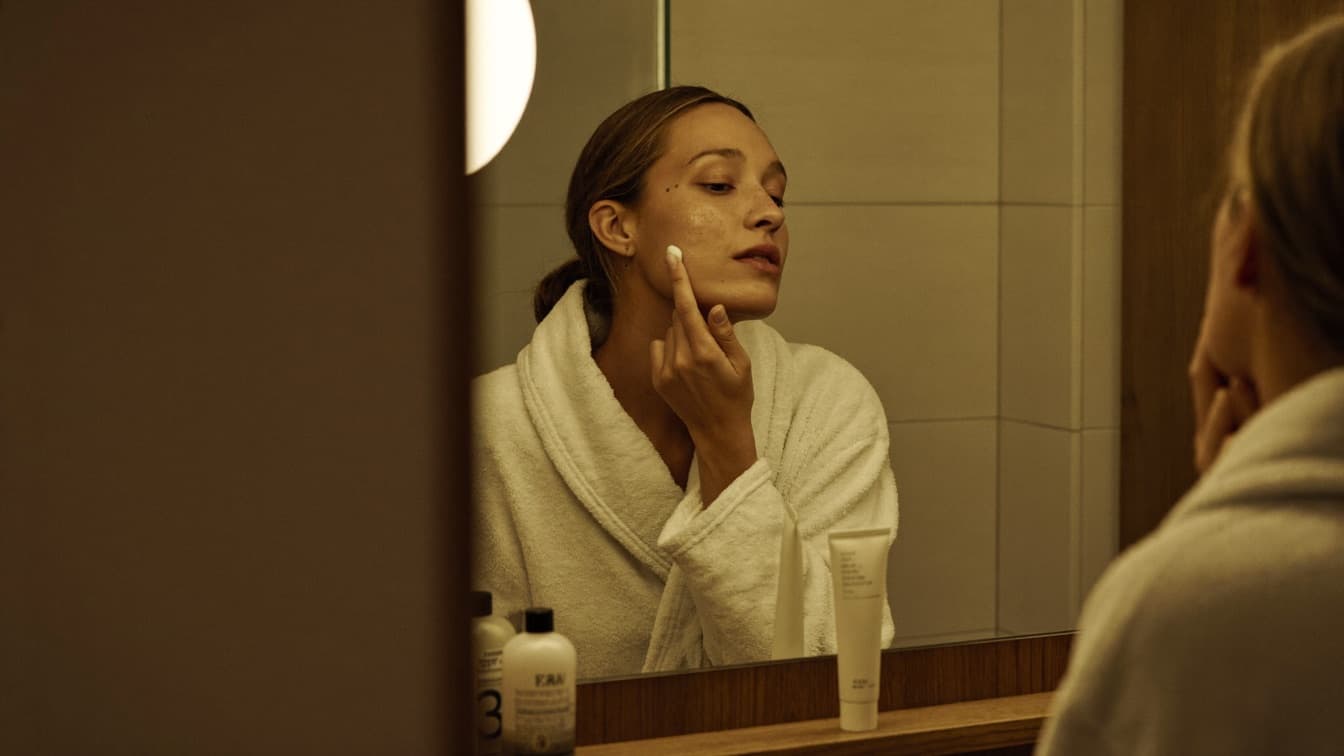
Use a pea-sized amount for your entire face. Not per area. For the whole face. This is the single most common mistake, and using three times as much does not accelerate anything; it only accelerates the irritation.
Start two or three nights a week, not nightly. Increase frequency only once you are comfortable at the current one, typically after two to four weeks. Reaching nightly use in month three is a completely normal pace.
Apply to dry skin. Wash, then wait ten to twenty minutes until your skin is fully dry. Applying to damp skin increases penetration and irritation without increasing benefit.
Moisturize. Either before tretinoin as a buffer, after it, or both. There is no evidence that moisturizer meaningfully blunts the result, and there is very good practical evidence that irritated people quit.
Avoid the delicate zones at first. Keep it off the corners of the nose, the corners of the mouth, and the immediate eyelid margin early on.
Wear sunscreen every morning. Broad spectrum, SPF 30 or above.
Pause other actives while adjusting. Exfoliating acids, scrubs, and strong vitamin C in the same routine are how tolerable becomes intolerable. Add them back once you are stable.
If your skin is still angry after four to six weeks of this, the answer is to drop back a step, not to push through. Irritation is not the mechanism of benefit, and the study that specifically looked at whether irritation predicted improvement did not find a clean relationship (https://pubmed.ncbi.nlm.nih.gov/8915171/).
Who should not use it, and when to stop
Tretinoin is avoided in pregnancy, and we stop it if you are trying to conceive. This is a firm rule, not a cautious one, and it is worth raising with us before it becomes urgent.
Active eczema, rosacea in flare, or a compromised skin barrier are reasons to treat something else first. Very sensitive skin may do better starting with a lower-strength retinoid or an over-the-counter retinol and moving up.
Waxing is a practical one people forget: tretinoin thins the outermost layer, and waxing treated skin can lift more than intended. Stop it about a week before any waxing on the treated area.
If you are also having in-office treatments, the sequencing matters. We generally pause tretinoin before and after peels and resurfacing, and our post on chemical peels covers those windows in more detail.
Where tretinoin fits in a real plan
Tretinoin does a lot, but it does not do everything, and honest expectation-setting is most of the value of seeing a clinician about it.
It improves fine lines, texture, pigmentation, and acne. It does not lift sagging skin, erase deep folds, or replace volume. It works alongside sunscreen rather than instead of it. If your concern is dynamic lines from muscle movement, that is a different tool, and our guide to Botox covers that side.
There are also alternatives worth knowing about. Tazarotene has been compared directly against tretinoin for photodamage (https://pubmed.ncbi.nlm.nih.gov/15203997/), and low-dose oral isotretinoin has been studied head-to-head against topical retinoic acid for photoaging (https://pubmed.ncbi.nlm.nih.gov/24168514/). Which one suits you depends on your skin, your tolerance, and what else you are treating.
The bottom line
Tretinoin is one of the very few things in skincare that earns the confidence people place in it. The evidence is old, deep, and consistent. The failure mode is almost never the molecule. It is starting too strong, using too much, and stopping at week six.
Start low, go slow, moisturize, wear sunscreen, and give it six months before you judge it.
If you want a prescription plan built around your skin rather than a generic strength and a hope, book a visit through our dermatology and aesthetics services at nomibeach.health or call (786) 744-5152. We will look at what you are actually treating, pick a starting strength you can tolerate, and check in during the adjustment period rather than leaving you to guess.
Frequently Asked Questions
- How long does tretinoin take to work?
- Longer than most people are told. Acne often looks worse before it looks better, with real improvement around eight to twelve weeks. For photoaging and fine lines, the controlled trials ran six months or more before measuring meaningful change (https://pubmed.ncbi.nlm.nih.gov/1552056/). If you quit at week six, you quit before the data says anything happens.
- Is the peeling and redness a sign it is working?
- No. Irritation and benefit are related but not the same thing. One study looking specifically at this question found clinical improvement did not track neatly with how irritated the skin got (https://pubmed.ncbi.nlm.nih.gov/8915171/). You can get the benefit at a tolerable dose. Peeling is a sign you are applying too much, too often, or too soon.
- What strength of tretinoin should I start with?
- Usually the lowest one. Trials of tretinoin 0.02% showed measurable improvement in photodamaged skin, so starting low is not starting ineffective (https://pubmed.ncbi.nlm.nih.gov/11534915/). We typically begin at 0.025% two or three nights a week and increase only once your skin is calm at that frequency.
- Can I use tretinoin if I am pregnant or trying to conceive?
- No. Topical retinoids including tretinoin are avoided in pregnancy, and we stop them if you are trying to conceive. If pregnancy is a possibility, tell us at the visit so we can plan an alternative rather than have you stop abruptly later.
- Do I need to wear sunscreen with tretinoin?
- Yes, daily, and not just because of sun sensitivity. Tretinoin is being used to repair photodamage, and continued unprotected sun exposure works directly against the thing you are paying for. Broad spectrum SPF 30 or higher every morning is part of the prescription, not an add-on.
- Can I use tretinoin with vitamin C, acids, or benzoyl peroxide?
- You can, but not all at once and usually not in the same application. We generally put vitamin C in the morning and tretinoin at night, and we pause exfoliating acids while your skin is adjusting. Benzoyl peroxide can be used, typically at a different time of day.
- What is the difference between tretinoin and over-the-counter retinol?
- Potency and directness. Tretinoin is the active form that binds skin receptors directly. Retinol has to be converted by your skin into that active form, which means less of it arrives and it works more slowly. Retinol is a reasonable starting point for sensitive skin; it is not an equivalent substitute.
Sources
- Olsen EA, Katz HI, Levine N, et al. Tretinoin emollient cream: a new therapy for photodamaged skin. J Am Acad Dermatol (1992);26(2 Pt 1):215-224.
- Bhawan J, Gonzalez-Serva A, Nehal K, et al. Effects of tretinoin on photodamaged skin. A histologic study. Arch Dermatol (1991);127(5):666-672.
- Thorne EG, et al. Effect of tretinoin emollient cream on photodamaged skin: relationship between clinical improvement and skin irritation. Br J Dermatol (1996);135(4):655-656.
- Nyirady J, Bergfeld W, Ellis C, et al. Tretinoin cream 0.02% for the treatment of photodamaged facial skin: a review of 2 double-blind clinical studies. Cutis (2001);68(2):135-142.
- Chien AL, Kim D, Cheng N, et al. Biomarkers of Tretinoin Precursors and Tretinoin Efficacy in Patients With Moderate to Severe Facial Photodamage: A Randomized Clinical Trial. JAMA Dermatol (2022);158(8):879-886.
- Reynolds RV, Yeung H, Cheng CE, et al. Guidelines of care for the management of acne vulgaris. J Am Acad Dermatol (2024);90(5):1006.e1-1006.e30.
- Zaenglein AL, Pathy AL, Schlosser BJ, et al. Guidelines of care for the management of acne vulgaris. J Am Acad Dermatol (2016);74(5):945-973.e33.
- Lowe N, Gifford M, Tanghetti E, et al. Tazarotene 0.1% cream versus tretinoin 0.05% emollient cream in the treatment of photodamaged facial skin: a multicenter, double-blind, randomized, parallel-group study. J Cosmet Laser Ther (2004);6(2):79-85.
- Wood E, et al. A Prospective, Randomized, Double-Blind, Vehicle-Controlled Study Evaluating the Efficacy, Safety, and Patient Satisfaction of Tretinoin 0.05% Lotion for Chest Rejuvenation. J Drugs Dermatol (2022);21(6):645-652.
- Bagatin E, Guadanhim LR, Enokihara MM, et al. Low-dose oral isotretinoin versus topical retinoic acid for photoaging: a randomized, comparative study. Int J Dermatol (2014);53(1):114-122.